

April 30, 2026
By Anik Islam
The Spring Economic Update 2026 rightly places affordability at the centre amid geopolitical uncertainty and persistent cost-of-living pressures. The update also reinforces the importance of investing in long-term climate resilience and economic competitiveness by accelerating clean innovation, advancing the energy transition and building more resilient infrastructure.
To achieve these objectives, maximizing the value of every public dollar will be critical. Attracting private investment (especially foreign direct investment) to finance major nation-building projects, like interprovincial electricity transmission grids or companies developing grid-scale storage, can deliver public goods with fewer public dollars.
This is where public financial institutions (PFIs) like the Business Development Bank of Canada and Export Development Canada become important. By sharing risks, attracting private capital and supporting projects and innovative firms, PFIs can use limited public dollars more effectively while advancing long-term competitiveness, climate and affordability objectives. Canada has several such institutions, including the newly announced Canada Strong Fund.
The spring update announced the federal government’s intention to review the mandates of PFIs to maximize their impact. There are trade-offs to navigate. Policymakers must balance strategic direction with operational independence and prioritize financing impact while ensuring financial sustainability. A key decision is whether to intervene at scale in mature sectors or pursue targeted interventions in emerging sectors to crowd in private capital. Overall, policymakers will need to determine how to pursue multiple priorities simultaneously, including growing Canada’s cleantech sector alongside investments in capital-heavy projects.
My current research examines how Canada can boost the impact of its PFIs to deliver greater public value and achieve broader climate and socioeconomic objectives. This blog summarizes some early findings based on an initial assessment of Canada’s public financing ecosystem and experiences from similar institutions in other countries.
Financing clean innovation firms and energy transition projects is inherently complex. These projects and entities carry different types of risks that vary across stages of innovation and growth.
For an innovative clean energy project, early stages involve significant engineering and design risks, particularly if the project involves first-of-a-kind technology. As the project moves toward construction, uncertainty around construction timelines, technical constraints and supply chain capacity can increase the risk of delays or failure. Questions about investability and profitability may also arise if there is uncertainty around long-term power prices. In addition, for companies looking to scale beyond Canada, additional risks can emerge around gaining market access, meeting foreign buyers’ demand and securing working capital to finance expansion.
These examples highlight the persistent market failure that hinders the financing of major clean technology innovation and energy projects. Without targeted support, private investors may not participate because such projects may not meet their required financial returns.
Our research brief, Bridging the Finance Gap, describes how PFIs can help address these financing gaps and make projects progressively more investable. PFIs use blended finance approaches by employing various financial instruments, such as loans, equity and guarantees, within financing structures to make projects attractive to private investors.
For example, a PFI might provide early-stage concessional loans or risk guarantees to innovative clean energy projects to absorb development- and construction-related risks. This financing can help make these projects commercially viable and more attractive to private lenders or institutional investors at later stages of project development.
The federal public investment landscape comprises a range of PFIs. Each PFI targets specific market failures and financing challenges across different stages of innovation and growth. For example, the Canada Growth Fund (CGF) supports innovative cleantech companies and low-carbon supply chain projects in the growth stages. The Canada Infrastructure Bank (CIB) supports mature revenue-generating infrastructure projects that can produce stable cash flow over time but struggle to attract early investment. These organizations are complemented by other federal, provincial and regional agencies that support investments across the country.
This differentiation in mandates allows each PFI to develop the necessary expertise and experience to properly serve the needs of Canada’s innovative businesses and nation-building projects. However, a broader set of institutions also creates a complex system with both gaps and areas of overlap. The table below provides a high-level overview of where different institutions support projects and innovative entities as they move from innovation to growth, maturity and expansion.
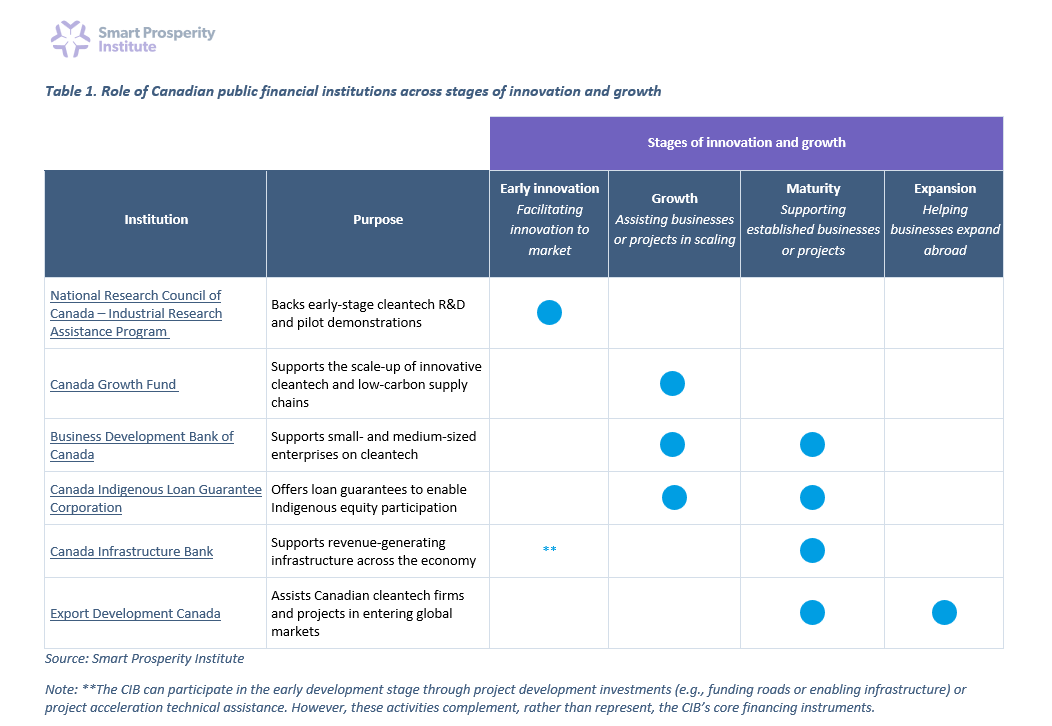
As Canada’s public financing ecosystem expands and evolves, the key question is how these institutions can maximize their impact. This entails both improving the effectiveness of individual institutions and strengthening the broader financing system in which they operate.
At the institutional level, PFIs differ in their mandates, operational flexibility and learning-by-doing capabilities. These factors shape how effectively taxpayer dollars are deployed in support of Canada’s climate and economic objectives.
At the system level, coordination becomes increasingly important. Without effective coordination, PFIs may find themselves in competition or fail to sequence and combine investments effectively in areas of strategic interest. The federal government’s strategic finance framework, first announced in budget 2025, signals recognition of the issue. The framework proposes a unified and coordinated approach to financing across federal Crown corporations, departments and agencies to align priorities and coordinate support for projects.
To support both institutional- and systems-level improvement, my research draws on early experiences of Canadian PFIs as well as lessons from international institutions such as those in the UK, Australia and the US. For example, I will look into how changes to the CIB’s earlier operational mandates, or the use of PSP Investments as fund manager for the CGF, can offer insights into the governance, operational flexibility and institutional capabilities needed for PFIs to operate effectively and meet their mandates.
Other jurisdictions and their institutions can provide useful insights into capital deployment, governance and strategic coordination, which can be adapted to Canadian policy conditions and inform the design of the federal strategic finance framework. As an example, the UK has adopted a “no wrong door” approach in which UK PFIs share a responsibility to communicate, direct proponents to the right organization and, where appropriate, collaborate to help investments move forward.
Alongside coordination, complementary steps could include aligning financing with sector-specific industrial strategies, creating a centralized inquiry/information portal for project proponents or innovative entities and strengthening the ability of PFIs to feed market intelligence from deal structuring back into policy design. These approaches are already being practiced in other jurisdictions and, if adapted well, can help strengthen the effectiveness of the Canadian public financing ecosystem.
Given the range of approaches and the evolving institutional landscape, the Smart Prosperity Institute will share research on the role of PFIs in financing clean innovation and the energy transition. This work will outline an organizing framework for understanding the different roles PFIs can play within the broader policy ecosystem. The research will also identify practical considerations to help Canada maximize the impact of its PFIs, both at the institutional level and across the broader financing system. Better-designed and better-coordinated PFIs can help Canada finance the next generation of nation-building projects, strengthen long-term economic resilience and accelerate the transition to a cleaner, more competitive economy.

Senior Research Associate

©2026 Smart Prosperity Institute. All rights reserved.
Contact us:
info@smartprosperity.ca | 1 Stewart St (3rd Floor), Ottawa, ON, K1N 6N5